Maximizing 2026 IRA: $7,500 Limit Strategy for High Earners
Advertisements
High earners can maximize the 2026 IRA contribution limit of $7,500 by implementing a strategic 4-step approach, optimizing retirement savings and leveraging available tax advantages for long-term financial growth.
For high earners navigating the complexities of retirement planning, maximizing the 2026 IRA contribution limit of $7,500 presents a significant opportunity. This guide outlines a comprehensive 4-step strategy designed to help you leverage this limit effectively, ensuring your financial future is both secure and optimized for growth.
Understanding the 2026 IRA Landscape and Contribution Limits
The landscape of retirement savings in the United States is constantly evolving, with annual adjustments to contribution limits reflecting economic shifts and legislative updates. For 2026, the Individual Retirement Account (IRA) contribution limit is set at $7,500 for those under age 50, with an additional catch-up contribution for those aged 50 and over. This figure is crucial for high earners who often face income limitations for direct Roth IRA contributions and tax deductibility for Traditional IRA contributions. Understanding these nuances is the first critical step in developing an effective strategy.
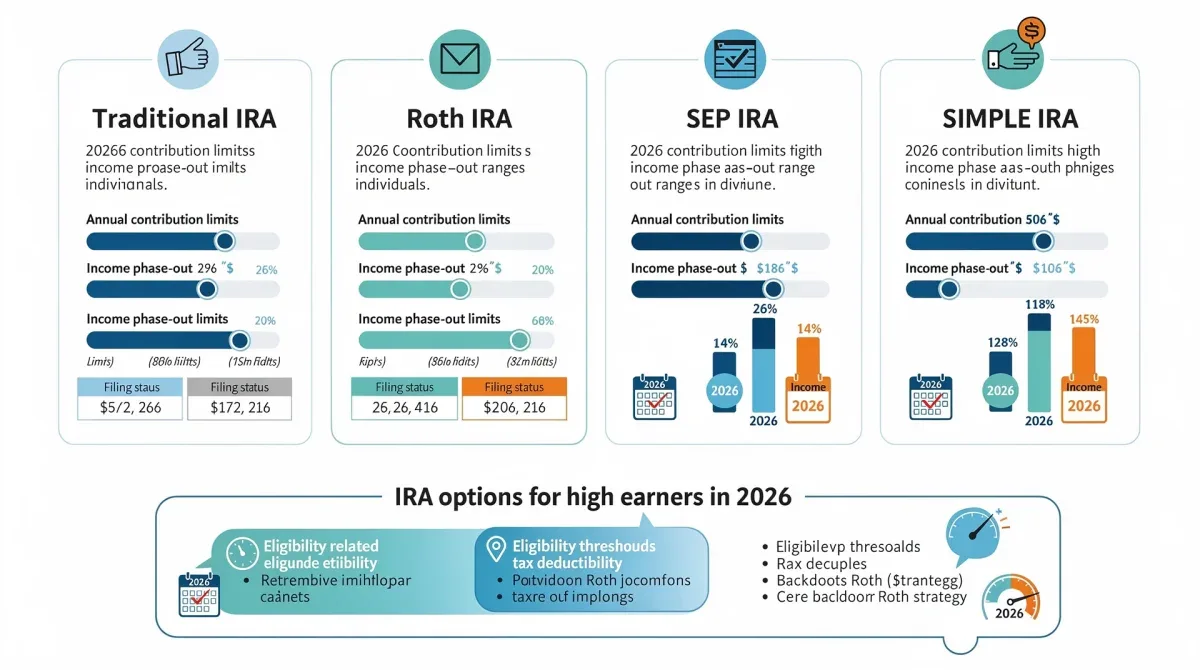
While the $7,500 limit applies broadly, the real challenge for high earners lies in navigating the income phase-out ranges. These ranges determine whether your contributions to a Traditional IRA are tax-deductible and if you can contribute directly to a Roth IRA. Exceeding these income thresholds doesn't necessarily mean you can't benefit from an IRA; it simply means you need a more sophisticated approach. Many high earners find themselves in a position where their adjusted gross income (AGI) disqualifies them from direct Roth contributions, making alternative strategies essential.
Traditional vs. Roth IRA: Which is right for you?
The choice between a Traditional and Roth IRA hinges on your current income, anticipated future income, and tax strategy. Traditional IRA contributions may be tax-deductible in the year they are made, leading to immediate tax savings, but withdrawals in retirement are taxed. Roth IRA contributions are made with after-tax dollars, meaning qualified withdrawals in retirement are tax-free. For high earners, the deductibility of Traditional IRA contributions often phases out at higher income levels, making the immediate tax benefit less accessible.
- Traditional IRA: Contributions may be tax-deductible, grows tax-deferred, taxed upon withdrawal in retirement.
- Roth IRA: Contributions are after-tax, grows tax-free, qualified withdrawals are tax-free in retirement.
- Income Limitations: High earners often exceed income limits for Roth IRA direct contributions and Traditional IRA deductibility.
- Catch-up Contributions: Individuals aged 50 and older can contribute an additional amount, further boosting retirement savings.
The decision between these two types of IRAs is not always straightforward, especially when considering the long-term implications of tax-deferred growth versus tax-free withdrawals. For high earners, the inability to directly contribute to a Roth IRA due to income limits often pushes them towards strategies like the backdoor Roth, which we will explore in detail.
In conclusion, a clear understanding of the 2026 IRA contribution limits and the income phase-out rules for both Traditional and Roth IRAs is foundational. This knowledge empowers high earners to assess their current eligibility and identify the most suitable path for maximizing their retirement savings within the established regulatory framework.
Step 1: Assess Your Eligibility and Income Limitations
Before implementing any strategy, a thorough assessment of your current financial situation, particularly your adjusted gross income (AGI), is paramount. High earners frequently encounter income limitations that restrict their ability to contribute directly to a Roth IRA or deduct Traditional IRA contributions. For 2026, these income phase-out ranges will be clearly defined by the IRS, and it's essential to consult the most up-to-date figures.
Your AGI plays a critical role in determining your eligibility for various tax benefits. If your AGI exceeds the established thresholds, you'll need to explore alternative routes to contribute to an IRA. This often means considering non-deductible Traditional IRA contributions as a precursor to a Roth conversion, a strategy commonly known as the backdoor Roth IRA. Understanding your specific income level relative to these limits will guide your subsequent actions.
Key income thresholds for 2026
While specific 2026 figures will be released closer to the year, historical trends suggest that the income phase-out ranges for Roth IRA contributions and Traditional IRA deductibility will continue to increase. For example, if you are single and your AGI exceeds a certain amount, you might not be able to contribute directly to a Roth IRA. Similarly, if you are covered by a retirement plan at work, the deductibility of your Traditional IRA contributions will also be subject to AGI limits.
- Roth IRA Phase-Out: If your AGI falls within or above the specified range, your ability to contribute directly to a Roth IRA is reduced or eliminated.
- Traditional IRA Deductibility Phase-Out: If you are covered by a workplace retirement plan, your AGI determines if your Traditional IRA contributions are fully, partially, or not deductible.
- Consult IRS Publications: Always refer to official IRS publications for the most accurate and current income limits for the 2026 tax year.
It's important not to assume ineligibility without first calculating your AGI. Various deductions and adjustments can lower your AGI, potentially bringing you back within eligibility ranges for direct contributions or full deductibility. This assessment should be a precise exercise, possibly involving a financial advisor to ensure accuracy.
In summary, the initial step involves a detailed analysis of your income and its implications for IRA contributions. This foundational understanding will dictate whether you can pursue a straightforward contribution or if a more advanced strategy is required to maximize the 2026 IRA limit.
Step 2: Utilize the Backdoor Roth IRA Strategy
For many high earners, the most effective way to circumvent Roth IRA income limitations and still benefit from tax-free growth in retirement is through the backdoor Roth IRA strategy. This involves making a non-deductible contribution to a Traditional IRA and then converting those funds to a Roth IRA. This two-step process allows individuals whose income exceeds the direct Roth contribution limits to effectively get money into a Roth account.
The beauty of the backdoor Roth IRA lies in its simplicity and legality. It leverages the fact that there are no income limits for making non-deductible contributions to a Traditional IRA, nor are there income limits for converting a Traditional IRA to a Roth IRA. The key is to ensure the Traditional IRA contribution is indeed non-deductible to avoid double taxation upon conversion.
Executing the backdoor Roth conversion
The process generally involves two distinct transactions. First, you contribute the maximum allowable amount (which is $7,500 for those under 50 in 2026) to a Traditional IRA. It is crucial that this contribution is designated as non-deductible on your tax return (Form 8606). Second, soon after the contribution, you convert the entire amount from the Traditional IRA to a Roth IRA. Because the initial contribution was non-deductible, the conversion itself is generally a non-taxable event, assuming you have no other pre-tax IRA money.
- Non-Deductible Contribution: Contribute $7,500 (or applicable limit) to a Traditional IRA, ensuring it's not deducted on your taxes.
- Prompt Conversion: Convert the funds from the Traditional IRA to a Roth IRA shortly after the contribution to minimize potential investment gains that would be taxable upon conversion.
- Pro-Rata Rule Awareness: Be mindful of the pro-rata rule if you hold other pre-tax Traditional IRA assets, as this can complicate the tax implications of the conversion.
The pro-rata rule is a critical consideration. If you have existing pre-tax funds in any Traditional, SEP, or SIMPLE IRA, the IRS views all your IRAs as a single account for conversion purposes. This means a portion of your conversion would be taxable. To avoid this, some high earners consider rolling over existing pre-tax IRA funds into a 401(k) or similar employer-sponsored plan, if permitted, before executing the backdoor Roth.
In conclusion, the backdoor Roth IRA is an indispensable tool for high earners aiming to maximize their 2026 IRA contributions. By strategically making non-deductible contributions and promptly converting them, you can bypass income limitations and secure the long-term tax advantages of a Roth IRA.
Step 3: Consider the Mega Backdoor Roth for Additional Savings
Beyond the standard backdoor Roth IRA, some high earners have an even more powerful tool at their disposal: the mega backdoor Roth. This strategy allows individuals to contribute significantly more than the standard IRA limits to a Roth account, leveraging their employer-sponsored 401(k) or similar plan. It's an advanced technique that can dramatically boost tax-free retirement savings, provided your employer's plan allows for it.
The mega backdoor Roth typically involves making after-tax contributions to your 401(k) plan, beyond the elective deferral limit. These after-tax contributions are then converted to a Roth 401(k) or rolled over into a Roth IRA. This strategy is particularly valuable because the combined total contributions to a 401(k) (employee deferrals, employer contributions, and after-tax contributions) can be substantial, often exceeding $60,000 annually, depending on IRS limits for 2026.

Requirements for a successful mega backdoor Roth
Not all employer plans support the mega backdoor Roth. For this strategy to be viable, your 401(k) plan must allow for two key features: after-tax contributions and in-service distributions (or rollovers). An in-service distribution allows you to move funds out of your 401(k) while still employed, which is essential for converting the after-tax contributions to a Roth account.
- Employer Plan Approval: Your 401(k) plan must permit after-tax contributions.
- In-Service Distributions: The plan must allow for in-service distributions or rollovers of after-tax funds to a Roth IRA or Roth 401(k).
- Contribution Limits: Be aware of the overall defined contribution plan limit for 2026, which includes all contributions (employee, employer, and after-tax).
The primary benefit is the ability to funnel a large amount of money into a Roth account, where it can grow tax-free for decades. This can be a game-changer for high earners who have already maxed out their traditional pre-tax 401(k) contributions and their regular IRA contributions. It represents an unparalleled opportunity to build a substantial tax-free nest egg.
In conclusion, the mega backdoor Roth is a sophisticated yet highly effective strategy for high earners to supercharge their retirement savings beyond conventional limits. It requires careful planning and confirmation of your employer's 401(k) plan features, but the rewards in terms of tax-free growth can be immense.
Step 4: Integrate Your IRA Strategy with Overall Financial Planning
Maximizing your 2026 IRA contribution is not an isolated event; it should be an integral part of your broader financial strategy. For high earners, this means aligning your IRA contributions with other retirement vehicles, investment goals, tax planning, and estate planning. A holistic approach ensures that each financial decision complements the others, leading to optimal outcomes.
Consider how your IRA contributions interact with your 401(k), other investment accounts, and even real estate holdings. Tax efficiency is key. For example, balancing pre-tax contributions (like a Traditional 401(k)) with after-tax Roth contributions provides flexibility in retirement, allowing you to draw from both tax-free and taxable accounts to manage your income tax bracket.

Balancing tax-advantaged accounts and investment diversification
Diversification extends beyond just asset classes; it also applies to the tax treatment of your retirement funds. Having a mix of pre-tax, tax-deferred, and tax-free accounts gives you greater control over your tax burden in retirement. This is especially important for high earners who may face higher tax rates during their working years but anticipate varying tax landscapes in retirement.
- Diversify Tax Treatment: Hold assets in Traditional IRAs/401(k)s (tax-deferred) and Roth IRAs/401(k)s (tax-free) to optimize future tax liabilities.
- Investment Allocation: Strategically allocate different types of investments across your various accounts based on their tax characteristics (e.g., high-growth investments in Roth accounts).
- Regular Review: Periodically review your entire financial plan, including IRA contributions, to adjust for life changes, market shifts, and updated tax laws.
Estate planning is another critical component. Roth IRAs, with their tax-free withdrawals, can be particularly attractive for leaving a legacy to beneficiaries, as they can inherit the account and continue to enjoy tax-free growth for a period. Consulting with a financial advisor who specializes in comprehensive wealth management can help you navigate these complex interdependencies.
In conclusion, integrating your IRA strategy into a holistic financial plan is essential for high earners. This involves considering tax implications, investment diversification across account types, and long-term estate planning to ensure your retirement savings efforts are maximized and aligned with your overall financial objectives.
Advanced Strategies and Common Pitfalls to Avoid
While the four-step strategy provides a robust framework for maximizing your 2026 IRA contributions, high earners should also be aware of advanced strategies and common pitfalls. The financial landscape is intricate, and proactive measures can prevent costly mistakes while unlocking further opportunities for growth. Understanding these nuances can significantly enhance the effectiveness of your retirement planning.
One advanced strategy involves strategic tax-loss harvesting in taxable accounts to offset gains or income, which can indirectly free up more capital for IRA contributions or other tax-advantaged savings. Another consideration is the timing of your contributions. While you have until the tax filing deadline to contribute for the previous year, contributing early in the year allows your money more time to grow tax-deferred or tax-free.
Avoiding common mistakes in IRA contributions
Several common errors can undermine even the best-laid plans. Misunderstanding the pro-rata rule for backdoor Roth conversions is a frequent pitfall, leading to unexpected tax liabilities. Another mistake is failing to accurately track non-deductible Traditional IRA contributions, which is crucial for avoiding double taxation when those funds are later converted or withdrawn.
- Pro-Rata Rule Misconception: Ensure you understand how existing pre-tax IRA funds affect backdoor Roth conversions to avoid unexpected taxes.
- Inaccurate Record Keeping: Maintain meticulous records of non-deductible IRA contributions using IRS Form 8606 to prevent double taxation.
- Ignoring Contribution Deadlines: Contribute early in the year to maximize growth potential, but always meet the tax filing deadline for the prior year's contributions.
- Overlooking State Taxes: Remember that while federal rules apply, state tax laws regarding IRA contributions and conversions can vary and impact your overall tax burden.
Furthermore, some high earners might overlook the impact of their modified adjusted gross income (MAGI) on other tax benefits, such as eligibility for certain deductions or credits. Every financial move has ripple effects, and a comprehensive understanding of these interactions is vital. Regular consultations with a tax professional and financial advisor are indispensable for navigating these complexities.
In conclusion, staying informed about advanced strategies and being vigilant about common pitfalls are crucial for high earners. Proactive planning, meticulous record-keeping, and expert guidance can help you optimize your 2026 IRA contributions and ensure your retirement savings plan remains robust and tax-efficient.
Future-Proofing Your Retirement: Beyond 2026 IRA Limits
While maximizing the 2026 IRA contribution limit is a pressing goal, high earners should also adopt a forward-looking perspective to future-proof their retirement savings. The financial landscape is dynamic, with potential changes in tax laws, inflation rates, and market conditions. A resilient retirement plan anticipates these shifts and builds in flexibility to adapt.
This involves not just focusing on annual contribution limits but also on broader economic trends and personal life stages. As your career progresses and your income potentially increases further, your retirement strategy will need to evolve. This might include exploring other sophisticated investment vehicles, philanthropic giving strategies, or even considering early retirement scenarios.
Adapting to economic changes and legislative updates
The rules governing retirement accounts are subject to legislative changes. What is allowed or advantageous in 2026 might be different in subsequent years. Staying informed about proposed tax reforms or adjustments to retirement account rules is crucial. Subscribing to financial news, consulting with advisors, and regularly reviewing your plan are essential practices.
- Stay Informed: Monitor legislative changes and IRS updates that could impact retirement contribution limits and rules.
- Long-Term Projections: Use financial planning software to model different scenarios, considering inflation, investment returns, and potential tax rate changes.
- Emergency Fund: Maintain a robust emergency fund to avoid needing to tap into retirement accounts prematurely.
- Diversify Investment Locations: Beyond tax-advantaged accounts, consider taxable brokerage accounts for additional investment flexibility and liquidity.
Moreover, your personal circumstances will undoubtedly change over time. Marriage, children, career shifts, and unexpected events all necessitate a review and potential adjustment of your retirement plan. What worked perfectly when you were 30 might not be suitable at 50. The key is to view retirement planning as an ongoing process, not a one-time event.
In conclusion, future-proofing your retirement involves looking beyond the immediate 2026 IRA limits. It requires continuous adaptation, staying informed about external changes, and regularly reassessing your personal financial goals to ensure your strategy remains robust and aligned with your evolving life circumstances.
| Key Strategy | Brief Description |
|---|---|
| Assess Eligibility | Determine your AGI to understand direct Roth IRA and Traditional IRA deductibility limits for 2026. |
| Backdoor Roth IRA | Make non-deductible Traditional IRA contributions and convert them to a Roth IRA to bypass income limits. |
| Mega Backdoor Roth | Utilize after-tax 401(k) contributions and convert/rollover to a Roth account if your employer's plan allows. |
| Integrate Financial Plan | Align IRA strategy with overall investment, tax, and estate planning for holistic wealth management. |
Frequently Asked Questions About 2026 IRA Contributions
What is the 2026 IRA contribution limit for high earners?▼The 2026 IRA contribution limit is $7,500 for individuals under age 50. For those aged 50 and older, an additional catch-up contribution is allowed, increasing the total amount. High earners must also consider income phase-out rules that affect direct Roth contributions and Traditional IRA deductibility.
Can high earners contribute directly to a Roth IRA in 2026?▼Direct contributions to a Roth IRA are subject to income limitations. High earners whose adjusted gross income (AGI) exceeds the IRS-specified thresholds for 2026 will likely be phased out or completely ineligible for direct Roth IRA contributions. In such cases, strategies like the backdoor Roth IRA become essential.
What is a backdoor Roth IRA and how does it work?▼A backdoor Roth IRA allows high earners to contribute to a Roth account despite income limits. It involves making a non-deductible contribution to a Traditional IRA, then converting those funds to a Roth IRA. This two-step process bypasses direct contribution restrictions, enabling tax-free growth and withdrawals in retirement.
Is the mega backdoor Roth strategy suitable for everyone?▼The mega backdoor Roth is not universally applicable. It requires your employer's 401(k) plan to allow after-tax contributions and in-service distributions. High earners should check with their plan administrator to confirm these features. It's an advanced strategy for those who have already maxed out other retirement savings avenues.
Why is it important to integrate IRA planning with overall finances?▼Integrating IRA planning with your overall financial strategy ensures all components work synergistically. This includes aligning contributions with investment goals, tax planning, and estate planning. A holistic approach helps high earners optimize tax efficiency, diversify investment locations, and build a resilient financial future, adapting to life changes and economic shifts.
Conclusion
Maximizing the 2026 IRA contribution limit of $7,500 is a critical component of a robust retirement strategy for high earners. By systematically assessing eligibility, leveraging the backdoor Roth and potentially the mega backdoor Roth strategies, and integrating these efforts into a comprehensive financial plan, individuals can significantly enhance their tax-advantaged savings. Proactive planning, informed decision-making, and a keen eye on legislative changes are paramount to securing a prosperous and tax-efficient retirement.