Proving Substantial Gainful Activity Below SSDI Limit: A Guide
Advertisements
Understanding Substantial Gainful Activity (SGA) limits is critical for Social Security Disability Insurance (SSDI) beneficiaries seeking to work without jeopardizing their benefits.
This guide outlines how to track and report earnings accurately, navigate work incentives, and maintain compliance while earning below the official monthly threshold.
Understanding Substantial Gainful Activity (SGA)
Substantial Gainful Activity (SGA) refers to a level of work activity and earnings that demonstrates an individual's ability to perform significant physical or mental duties. The SSA uses this criterion to determine if a person is truly unable to engage in substantial work due to their disability.
The monetary threshold for SGA is adjusted annually, reflecting changes in the national average wage index. For 2024, the non-blind SGA limit stands at $1,620 per month, a figure that requires careful monitoring by all SSDI recipients.
It is important to note that SGA is not solely about gross income; the SSA also considers the nature of the work performed, the number of hours worked, and any special accommodations made by an employer. These factors can influence how earnings are evaluated against the SGA limit.
Defining the SGA Limit and Its Implications
The SGA limit acts as a critical benchmark for SSDI beneficiaries. If your gross monthly earnings consistently exceed this amount, the SSA may determine that you are no longer considered disabled under their rules, leading to a cessation of benefits.
This limit applies to both earned income from employment and net earnings from self-employment. Understanding how different types of income are calculated is essential for accurate reporting and maintaining eligibility.
The implications of exceeding the SGA limit extend beyond just a loss of benefits; it can trigger a review of your disability status, which can be a lengthy and stressful process. Therefore, proactive management of income is key.
Tracking and Reporting Your Income Accurately
Accurate tracking and reporting of all income sources are fundamental for SSDI beneficiaries. This diligence ensures that your earnings remain below the SGA threshold and that you avoid any potential issues with the SSA.
Maintaining detailed records of pay stubs, bank statements, and any other income-related documentation is a non-negotiable step. These records serve as concrete evidence of your earnings and work activity.
The SSA requires timely reporting of any changes in work status or income. Failing to report these changes can result in overpayments, which the SSA will then seek to recover, often with penalties.
Essential Documentation for Proving Substantial Gainful Activity
Pay stubs: Keep every pay stub, noting gross earnings, hours worked, and any deductions.
Bank statements: Regularly review bank statements to reconcile reported income with deposits.
Tax returns: Annual tax returns provide a comprehensive overview of your yearly earnings.
Self-employment records: Maintain meticulous records of income and expenses for self-employment.
Beyond standard pay stubs, individuals engaged in self-employment must keep detailed ledgers of all business transactions. This includes invoices, receipts for expenses, and profit/loss statements, all crucial for Proving Substantial Gainful Activity.
For those with fluctuating income, it is advisable to track earnings on a weekly or bi-weekly basis, then project monthly totals. This proactive approach helps in identifying potential over-SGA situations before they occur.
Understanding Work Incentives and Exclusions
The SSA offers various work incentives designed to encourage SSDI beneficiaries to return to work without immediately losing their benefits. These programs allow individuals to test their ability to work while still receiving support, and are vital for Proving Substantial Gainful Activity.
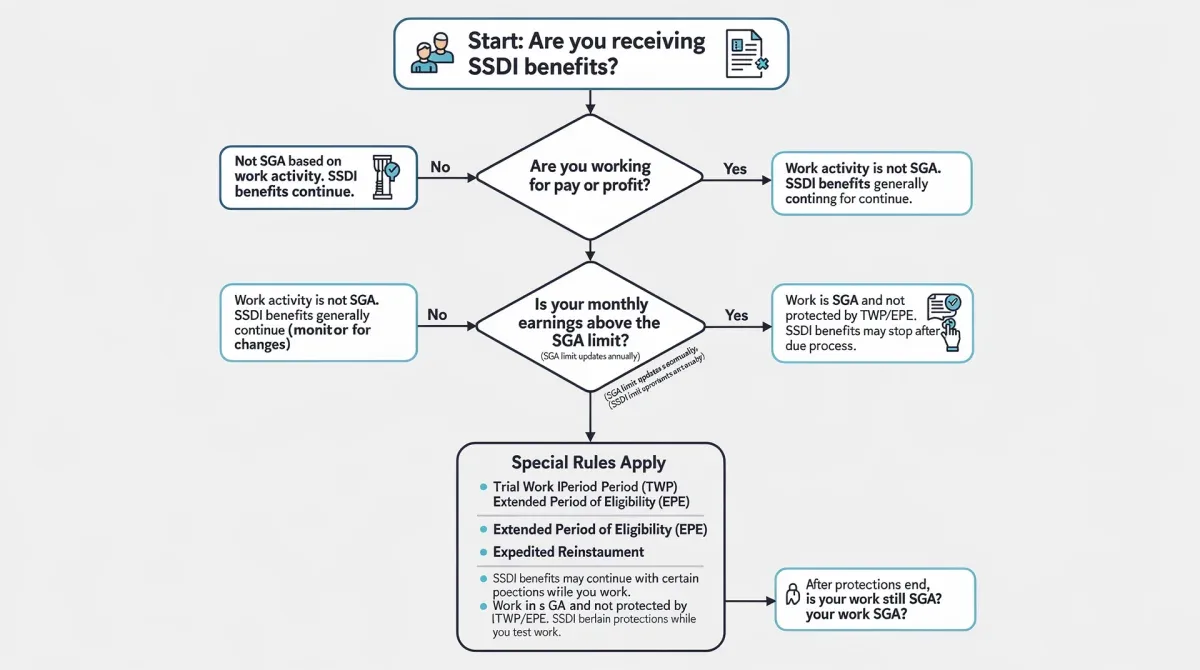
Key work incentives include the Trial Work Period (TWP), the Extended Period of Eligibility (EPE), and Impairment-Related Work Expenses (IRWE). These provisions can significantly impact how your earnings are counted against the SGA limit.
Familiarizing yourself with these incentives is crucial for maximizing your earning potential while maintaining SSDI eligibility. Many beneficiaries are unaware of these valuable tools, potentially limiting their opportunities.
Trial Work Period (TWP) Explained
During a Trial Work Period (TWP), you can work and earn any amount without affecting your SSDI benefits. The SSA considers a month a TWP month if your gross earnings exceed a certain amount (for 2024, this is $1,110) or if you work more than 80 hours in self-employment.
The TWP lasts for nine months within a 60-month period. These nine months do not have to be consecutive. Once you have used all nine TWP months, your benefits enter a different phase, which is important for Proving Substantial Gainful Activity.
It is essential to continue reporting your work activity during the TWP, even though your benefits are not immediately affected. This reporting ensures the SSA has accurate records for when the TWP concludes.
Impairment-Related Work Expenses (IRWE)
Impairment-Related Work Expenses (IRWE) are costs associated with your disability that you incur to work. These expenses can be deducted from your gross earnings when the SSA calculates if your work is SGA.
Examples of IRWE include the cost of certain medications, medical devices, specialized transportation, or attendant care. These expenses must be paid by you and directly related to enabling you to work despite your impairment.
Documenting these expenses meticulously with receipts and explanations is vital. The SSA will only consider IRWE if they are reasonable and necessary for your work, directly assisting in Proving Substantial Gainful Activity below the threshold.
Navigating the Extended Period of Eligibility (EPE)
After completing your Trial Work Period, you enter the Extended Period of Eligibility (EPE), which lasts for 36 consecutive months. During this period, the SSA determines your eligibility for benefits based on whether your earnings are above or below the SGA limit each month.
If your earnings fall below the SGA limit in any month during the EPE, you will receive your full SSDI benefits for that month. If your earnings exceed the SGA limit, your benefits will generally be suspended for that month.
This period offers a safety net, allowing beneficiaries to test their ability to sustain work over a longer duration. Understanding the EPE is crucial for long-term benefit planning and for Proving Substantial Gainful Activity effectively.
What Happens During the EPE
During the EPE, if your work activity is determined to be SGA, your benefits will be suspended. However, if your earnings drop below the SGA limit within the 36-month period, your benefits can be reinstated without a new application.
This automatic reinstatement is a significant advantage, preventing the need to reapply for benefits if your work attempt is unsuccessful. It provides flexibility and encourages individuals to pursue employment opportunities while ensuring continued support.
It is imperative to continue reporting all work and earnings to the SSA throughout the EPE. This ensures accurate benefit payments and helps avoid any complications or overpayments, especially when Proving Substantial Gainful Activity.
The Role of Employer Accommodations and Subsidies
When assessing SGA, the SSA also considers any special conditions or accommodations provided by your employer. These factors can reduce the actual value of your work for SGA purposes, even if your gross earnings are above the limit.
Employer subsidies occur when an employer pays you more than the actual value of the services you perform due to your disability. This often happens out of sympathy or a desire to help, rather than a reflection of your productivity.
Similarly, special accommodations, such as reduced workload, flexible hours, or assistance from co-workers, can indicate that your work is not truly "substantial" in the same way as someone without a disability. These are key aspects for Proving Substantial Gainful Activity.
Identifying Subsidies and Special Conditions
To identify a subsidy, you or your employer might need to provide a statement to the SSA explaining why your wages are higher than the actual value of your work. This could involve comparing your pay to that of non-disabled employees performing similar tasks.
Special conditions should also be documented. If your employer provides significant support or makes adjustments that enable you to work, these details are crucial. These factors help the SSA understand the true nature of your work activity.
It is important to communicate openly with your employer about your SSDI status and the need to document these accommodations. Their cooperation is often vital in providing the SSA with the necessary information for Proving Substantial Gainful Activity below the threshold.
Seeking Professional Guidance and Support
Navigating the complex rules and regulations surrounding SSDI and SGA can be challenging. Seeking professional guidance from disability advocates, attorneys, or SSA representatives can provide invaluable support and clarity.
These professionals possess in-depth knowledge of SSA policies and can help you understand your rights and responsibilities. They can also assist in preparing documentation and communicating with the SSA on your behalf.
Do not hesitate to reach out for help if you are unsure about any aspect of Proving Substantial Gainful Activity or managing your SSDI benefits. Early intervention can prevent potential issues and ensure continued eligibility.
Consulting with the Social Security Administration
The Social Security Administration itself is a primary resource for beneficiaries. You can contact them directly to ask questions, report changes, or request clarification on specific policies related to your benefits.
SSA field offices offer in-person assistance, and their national toll-free number provides access to representatives who can guide you. Always keep a record of your communications, including dates, names of representatives, and summaries of discussions.
Leveraging these direct channels ensures you receive accurate and up-to-date information, which is paramount for Proving Substantial Gainful Activity and maintaining your SSDI benefits.
Avoiding Common Pitfalls and Ensuring Compliance
One of the most common pitfalls for SSDI beneficiaries is failing to report changes in work status or income promptly. This oversight can lead to serious consequences, including benefit overpayments and the need for repayment.
Another error involves misunderstanding the difference between gross and net earnings, especially for self-employment. The SSA generally considers gross earnings for employees but net earnings for self-employed individuals, after allowable business expenses.
Carefully reviewing all SSA correspondence and responding promptly to requests for information is also critical. Ignoring these communications can result in benefit suspensions or terminations, making Proving Substantial Gainful Activity more difficult.
Key Strategies for Ongoing Compliance
Report all income: Even if you believe your earnings are below SGA, report them to the SSA.
Keep detailed records: Maintain comprehensive documentation of all work-related income and expenses.
Understand work incentives: Utilize programs like TWP and IRWE to maximize earning potential.
Seek clarification: If in doubt, contact the SSA or a disability professional for guidance.
Proactive engagement with the SSA and diligent record-keeping are your best defenses against compliance issues. Stay informed about annual SGA limit adjustments and how they might affect your individual situation.
By consistently adhering to these guidelines, beneficiaries can effectively manage their work activities while continuing to receive the SSDI benefits they rely on. This meticulous approach is essential for Proving Substantial Gainful Activity.

The Importance of Medical Evidence and Continued Disability
While Proving Substantial Gainful Activity below the limit focuses on earnings, it is crucial to remember that your underlying medical condition remains central to your SSDI eligibility. The SSA periodically reviews cases to ensure individuals still meet the definition of disability.
Maintaining up-to-date medical records and continuing treatment are vital. These records serve as ongoing evidence of your disability and its impact on your ability to work, reinforcing your claim for benefits.
Engaging in work, even below the SGA limit, does not automatically mean your disability has improved. The SSA recognizes that many individuals can perform some work with significant limitations or accommodations.
Preparing for Continuing Disability Reviews (CDRs)
The SSA conducts Continuing Disability Reviews (CDRs) to determine if your medical condition has improved to the point where you are no longer considered disabled. These reviews occur at varying intervals, depending on the nature of your disability.
During a CDR, the SSA will request updated medical evidence from your doctors and may ask about your daily activities and any work you have performed. Your consistent medical treatment records are paramount here.
Having a clear understanding of your medical condition and its limitations, along with accurate work records for Proving Substantial Gainful Activity, will significantly strengthen your position during a CDR. It's about demonstrating both medical and financial compliance.
Key Point | Brief Description |
|---|---|
SGA Limit 2024 | $1,620 monthly for non-blind individuals; exceeding it impacts SSDI benefits. |
Income Reporting | Mandatory and timely reporting of all earnings and work changes to SSA. |
Work Incentives | Programs like TWP, EPE, and IRWE allow beneficiaries to work and maintain benefits. |
Professional Guidance | Seek advice from advocates or SSA for complex situations and compliance. |
Frequently Asked Questions About SGA and SSDI
What is the current Substantial Gainful Activity (SGA) limit for SSDI?▼
For non-blind individuals in 2024, the Substantial Gainful Activity (SGA) limit is $1,620 per month. This figure is reviewed and adjusted annually by the Social Security Administration to reflect changes in the national average wage index.
How do I report my earnings to the Social Security Administration (SSA)?▼
You should report your earnings to the SSA promptly by phone, mail, or in person at a local office. Provide pay stubs or other income documentation. Consistent and timely reporting is crucial for Proving Substantial Gainful Activity below the limit and maintaining benefits.
Can I work part-time and still receive SSDI benefits?▼
Yes, you can work part-time and receive SSDI benefits, provided your earnings do not exceed the SGA limit. The SSA also offers work incentives like the Trial Work Period to encourage work without immediate benefit loss, which helps with Proving Substantial Gainful Activity.
What are Impairment-Related Work Expenses (IRWE)?▼
IRWE are costs related to your disability that are necessary for you to work, such as specialized transportation or medical devices. These expenses can be deducted from your gross earnings when the SSA calculates SGA, aiding in Proving Substantial Gainful Activity below the limit.
What happens if I exceed the SGA limit during my Extended Period of Eligibility (EPE)?▼
If you exceed the SGA limit during your EPE, your benefits will be suspended for that month. However, if your earnings fall below SGA again within the 36-month EPE, your benefits can be reinstated without a new application, crucial for Proving Substantial Gainful Activity.
What this means
The detailed guide on proving Substantial Gainful Activity (SGA) below the monthly threshold clarifies critical steps for disability beneficiaries.
It underscores the importance of accurate earnings reporting, leveraging official work incentives, and seeking professional guidance, while staying aligned with the official SSA Substantial Gainful Activity limits.
This information is vital for thousands of Americans relying on SSDI benefits. Future developments may include annual adjustments to the SGA limit or changes in reporting requirements, emphasizing the need for ongoing vigilance and proactive management of one's financial and medical records.
Staying informed and compliant ensures that individuals can navigate the complexities of disability benefits effectively, supporting their financial stability while engaging in work activities that align with their capabilities.