HELOC vs. Fixed-Rate Home Equity Loan: Which Saves More?
Advertisements
Choosing between a HELOC and a fixed-rate home equity loan for a $50,000 borrowing in 2026 at 7.2% fixed requires evaluating flexibility versus predictable payments, with market conditions and personal financial goals dictating the optimal choice for maximum savings.
Considering a home equity product for a $50,000 borrowing in 2026? The choice between a HELOC vs Fixed-Rate Loan at a hypothetical 7.2% fixed interest rate is a critical financial decision that can significantly impact your savings and overall financial well-being. Understanding the nuances of each option is key to making an informed choice.
Understanding the Home Equity Line of Credit (HELOC)
A Home Equity Line of Credit, or HELOC, operates much like a credit card, but it's secured by your home's equity. This means you're approved for a specific credit limit, and you can draw funds as needed, repaying what you borrow. The interest rate on a HELOC is typically variable, tied to a benchmark index like the prime rate, which means your payments can fluctuate over time.
The allure of a HELOC lies in its flexibility. You only pay interest on the amount you actually use, not the entire credit line. This makes it particularly attractive for ongoing projects or unexpected expenses where the exact total cost isn't known upfront. However, this flexibility comes with the inherent risk of variable interest rates.
How HELOCs work: Draw and repayment periods
A HELOC usually has two distinct phases: the draw period and the repayment period. During the draw period, which can last 5 to 10 years, you can access funds, make interest-only payments, or pay down the principal. Once the draw period ends, the repayment period begins, typically lasting 10 to 20 years, during which you must repay both principal and interest.
- Draw Period Flexibility: Access funds as needed, ideal for phased projects.
- Variable Interest Rates: Rates can change, impacting monthly payments.
- Interest-Only Payments: Often an option during the draw period, potentially lowering initial costs.
- Principal Repayment: Required during the repayment period, leading to higher payments.

It's crucial to understand that while interest-only payments might seem appealing initially, they can lead to a significant payment jump when the repayment period begins. This shift can be a financial shock if not properly planned for, especially if interest rates have risen.
The primary advantage of a HELOC is its adaptability. If you're undertaking a renovation project that unfolds in stages, a HELOC allows you to draw funds as each stage demands, preventing you from borrowing more than you immediately need. This can lead to significant interest savings compared to taking out a lump sum loan for a project whose total cost might be overestimated or whose timeline is uncertain.
However, the variable nature of HELOC interest rates introduces an element of unpredictability. In an environment of rising interest rates, your monthly payments could increase, potentially straining your budget. This is a critical factor to consider, especially when projecting costs for 2026 and beyond. Evaluating your risk tolerance for fluctuating payments is paramount before committing to a HELOC.
Exploring the Fixed-Rate Home Equity Loan
In contrast to the HELOC, a fixed-rate home equity loan provides a lump sum of money upfront, which you repay over a set period with a consistent monthly payment. The interest rate remains the same throughout the life of the loan, offering predictability and stability in your financial planning.
For those who prefer certainty in their budget, a fixed-rate loan is often the preferred choice. You know exactly what your monthly payment will be, making it easier to manage your finances without the worry of interest rate fluctuations. This option is particularly well-suited for a one-time, significant expense with a clearly defined cost.
Predictable payments and budgeting stability
The most significant benefit of a fixed-rate home equity loan is the peace of mind that comes with predictable payments. This stability allows for precise budgeting, ensuring you can comfortably meet your obligations without surprises. This is a powerful advantage in a volatile economic climate.
- Lump Sum Disbursement: Receive all funds at once.
- Consistent Monthly Payments: Easy to budget, no surprises.
- Fixed Interest Rate: Rate remains the same for the entire loan term.
- Defined Repayment Schedule: Clear end date for the loan.
While the stability is appealing, fixed-rate loans lack the flexibility of a HELOC. If you borrow more than you ultimately need, you'll still pay interest on the full amount. Conversely, if your project costs more than anticipated, you'll need to seek additional financing, which could mean another loan application and associated fees.
A fixed-rate home equity loan at 7.2% offers a clear advantage in terms of budgeting. For a $50,000 loan, you would know your exact monthly payment from day one until the loan is fully repaid. This eliminates the stress of monitoring interest rate movements and adjusting your budget accordingly. It’s ideal for a single, large expense like a full kitchen remodel or consolidating high-interest debt.
However, this predictability comes at the cost of flexibility. If your needs change or you find you don't require the full $50,000, you will still be repaying the entire principal plus interest. There’s no option to only pay on what you use, unlike a HELOC. This can sometimes lead to paying more interest than necessary if your borrowing needs shrink over time.
Interest Rate Dynamics: Variable vs. Fixed at 7.2%
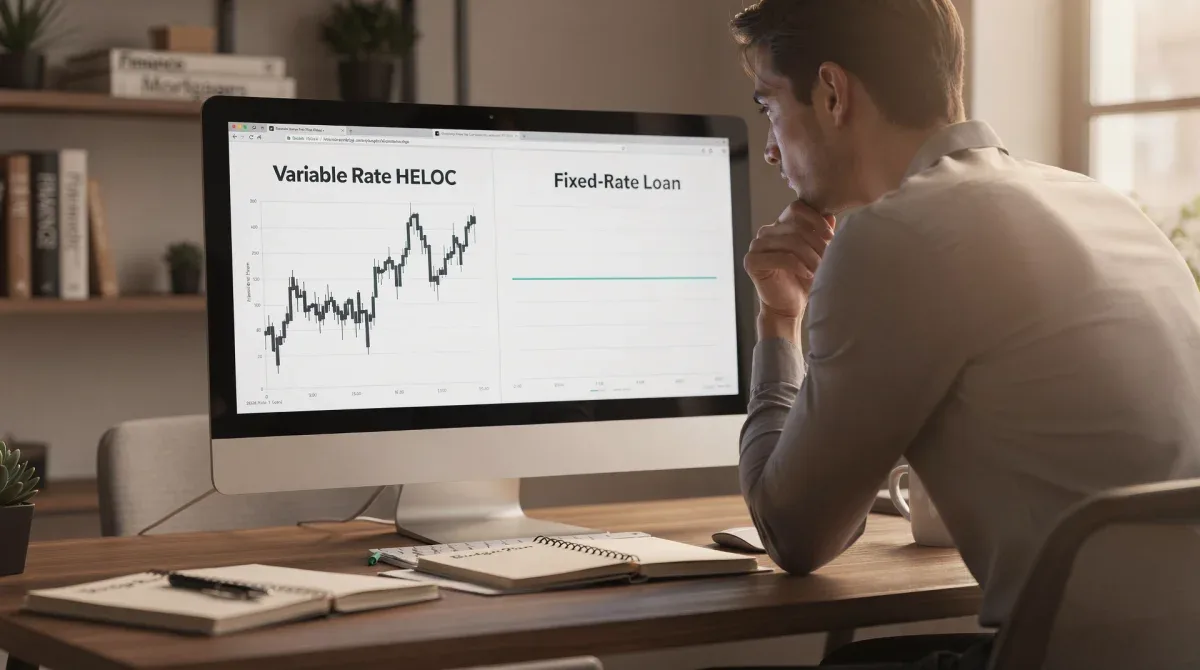
The core difference between a HELOC and a fixed-rate home equity loan revolves around their interest rate structures. A HELOC typically features a variable rate, meaning it can change based on market conditions. A fixed-rate loan, as the name suggests, locks in your rate for the entire loan term, such as the 7.2% specified.
In 2026, understanding the economic outlook is crucial. If interest rates are projected to rise, a fixed-rate loan at 7.2% could offer significant savings over a HELOC whose rate might climb. Conversely, if rates are expected to fall, a HELOC could potentially become cheaper over time, though this is a speculative gamble.

The impact of market fluctuations on HELOCs
HELOC rates are usually tied to a benchmark index, like the prime rate, plus a margin set by the lender. When the prime rate increases, your HELOC interest rate and subsequent monthly payments will also increase. This can make budgeting challenging and introduce financial uncertainty.
- Prime Rate Influence: Directly impacts HELOC interest rates.
- Economic Forecasts: Essential for anticipating rate movements.
- Payment Volatility: Monthly payments can fluctuate significantly.
- Rate Caps: Some HELOCs have caps, limiting how high rates can go.
The 7.2% fixed rate provides a clear baseline for comparison. If the average HELOC rate (prime plus margin) is projected to stay below 7.2% for the majority of your borrowing period, a HELOC might theoretically offer savings. However, the risk of it exceeding 7.2% is ever-present with a variable rate product. This is where your personal risk assessment becomes paramount.
When comparing a HELOC's variable rate to a fixed 7.2% home equity loan, the economic forecast for 2026 is a significant consideration. If economists predict a period of rising interest rates, the 7.2% fixed rate acts as a protective shield, locking in your borrowing cost. A HELOC's rate could potentially surpass 7.2% over its draw or repayment period, leading to higher overall interest payments.
Conversely, if interest rates are expected to decline, a HELOC might eventually offer a lower effective rate than 7.2%. However, this comes with the inherent uncertainty of predicting future market movements. For many homeowners, the security of a fixed rate, even if it might be slightly higher than a temporary low HELOC rate, is a compelling factor for long-term financial stability.
Comparing Total Cost: $50,000 Borrowing Scenario
Let's consider a hypothetical $50,000 borrowing scenario in 2026. To truly determine which option saves more, we need to look beyond just the nominal interest rate and consider the total cost over the life of the loan, including fees, repayment structure, and the impact of potential interest rate changes.
For a fixed-rate home equity loan at 7.2% over, say, a 10-year term, your monthly payments and total interest paid would be precisely calculable. With a HELOC, the total cost is much more fluid, depending on how much you draw, when you draw it, and how interest rates behave.
Illustrative repayment models
Imagine using the full $50,000 instantly. For a fixed-rate loan at 7.2% over 10 years, your monthly payment would be constant. For a HELOC, if you drew the full $50,000 and the rate started at, for example, 6.5% but climbed to 8% during the repayment phase, your payments would increase, leading to higher overall interest paid.
- Fixed Loan Calculation: Simple, predictable amortization schedule.
- HELOC Variability: Requires dynamic calculation based on draws and rate changes.
- Fees: Both options may have closing costs, appraisal fees, and annual fees.
- Early Repayment: Consider prepayment penalties, though less common now.
The key to maximizing savings is aligning the loan product with your specific borrowing needs and risk tolerance. If you need the full $50,000 at once and value stability, the fixed-rate loan is likely to save you more in the long run by eliminating rate uncertainty. If you need funds intermittently and are comfortable with rate fluctuations, a HELOC might offer savings by only charging interest on the drawn amount.
For a $50,000 borrowing, if you require the entire sum upfront and plan to repay it diligently, the fixed-rate loan at 7.2% offers an undeniable advantage in terms of predictable savings. You can calculate the total interest paid over the life of the loan and stick to a consistent budget. This certainty helps in avoiding unforeseen increases in monthly payments that could derail your financial plans.
Conversely, if you anticipate needing funds intermittently for a project, say $10,000 now, another $20,000 in six months, and the remaining $20,000 a year later, a HELOC could potentially save you interest. You would only pay interest on the $10,000, then $30,000, and finally $50,000 as you draw. If the variable rate remains below or near 7.2% on average, this staged borrowing could lead to lower overall interest than borrowing the full $50,000 with a fixed loan immediately.
Evaluating Your Financial Goals and Risk Tolerance
The decision between a HELOC and a fixed-rate home equity loan is highly personal and should be based on your unique financial situation, goals, and comfort level with risk. There's no one-size-fits-all answer; what saves one person money might cost another.
Consider the purpose of the funds. Are you consolidating high-interest debt, undertaking a home renovation, or funding education? Each use case might lean towards one product over the other. Also, honestly assess your ability to handle potential payment increases with a variable-rate product.
Key questions to ask yourself
Before making a decision, reflect on these questions to guide your choice. Your answers will illuminate which loan structure best fits your financial philosophy and current circumstances.
- How will interest rates move in 2026 and beyond? Consider expert forecasts.
- How certain are your borrowing needs? Is it a lump sum or staggered draws?
- Can your budget absorb higher payments? Assess your financial flexibility.
- How long do you plan to repay the loan? Longer terms amplify rate impact.
If predictability and peace of mind are paramount, and you have a clear, immediate need for the $50,000, the fixed-rate home equity loan at 7.2% is likely your best bet for maximizing savings and minimizing stress. If you value flexibility, anticipate staggered draws, and are comfortable with market fluctuations, a HELOC might be more advantageous, provided you monitor rates diligently.
When evaluating your financial goals, consider if you prioritize stability or flexibility. If your primary goal is to have a predictable monthly expense and you are averse to market risks, the fixed-rate home equity loan at 7.2% will likely offer you greater peace of mind and, potentially, more savings if interest rates rise significantly. This certainty allows for better long-term financial planning without the need to constantly monitor economic indicators.
On the other hand, if your financial strategy involves leveraging credit lines for intermittent projects or unforeseen expenses, and you are comfortable with the ebb and flow of interest rates, a HELOC might be more aligned with your needs. The ability to only borrow and pay interest on the exact amount needed can lead to substantial savings if your total borrowing remains below the full $50,000 over time. It requires a more active management approach but offers greater control over when and how much you access your home equity.
Potential Pitfalls and Considerations for Both Options
While both HELOCs and fixed-rate home equity loans offer valuable ways to access your home equity, they come with their own set of potential pitfalls. Being aware of these can help you avoid costly mistakes and ensure you make the most financially sound decision for your situation.
For HELOCs, the primary concern is the variable interest rate, which can lead to unexpected payment increases. For fixed-rate loans, the main drawback is the lack of flexibility and the commitment to repaying a lump sum, even if not fully utilized.
Understanding the risks
Delving deeper into the risks associated with each product reveals scenarios where one might be significantly less favorable than the other. It's not just about interest rates, but also about the terms and conditions.
- HELOC Payment Shock: Substantial payment increases when the draw period ends.
- Fixed Loan Over-Borrowing: Paying interest on funds you don't use.
- Home as Collateral: Both loans use your home as security, risking foreclosure if you default.
- Fees and Closing Costs: Be aware of all associated charges, which can reduce savings.
Another crucial consideration for both is the impact on your credit score. Missing payments on either can severely damage your credit, making future borrowing more difficult and expensive. Always ensure your repayment plan is sustainable given your income and expenses.
With a HELOC, a significant pitfall is the potential for payment shock when the draw period transitions to the repayment period. If you've been making interest-only payments, the sudden requirement to pay principal plus interest, compounded by potentially higher variable rates, can create a substantial burden. It’s vital to model out these future payments and ensure your budget can accommodate them.
For a fixed-rate home equity loan, the main consideration is the commitment to the full $50,000. If your project or need is smaller than anticipated, or if you manage to complete it under budget, you are still obligated to repay the entire amount. This means you could be paying interest on funds you didn't truly need or utilize, effectively reducing your overall savings compared to a more flexible option.
Strategies to Maximize Savings in 2026
Regardless of whether you choose a HELOC or a fixed-rate home equity loan, there are proactive strategies you can employ to maximize your savings in 2026 and beyond. These involve careful planning, diligent management, and a keen eye on financial opportunities.
The overarching goal is to minimize the amount of interest you pay over the life of the loan. This can be achieved through various means, from making extra payments to refinancing, depending on the loan type and market conditions.
Smart repayment tactics
Implementing smart repayment tactics can significantly reduce your total interest paid, freeing up funds for other financial goals. Even small adjustments can make a big difference over time.
- Extra Payments: Apply additional funds directly to the principal to reduce interest.
- Bi-Weekly Payments: Pay half your monthly payment every two weeks, resulting in an extra payment per year.
- Refinancing: Consider refinancing if interest rates drop significantly (for fixed loans) or if your HELOC rate becomes too high.
- Budgeting & Tracking: Maintain a strict budget to ensure timely and sufficient payments.
For a HELOC, actively monitoring interest rates and making larger payments during periods of low rates can be highly beneficial. For a fixed-rate loan, consistently making extra principal payments, even small ones, can shave years off your loan term and save thousands in interest.
To maximize savings with a HELOC, actively manage your draws and repayments. If you have fluctuating income, consider making larger payments when your finances allow to reduce your outstanding balance. Additionally, keep a close watch on the prime rate. If it begins to trend upwards, consider converting a portion of your HELOC balance to a fixed-rate option if your lender offers that feature, locking in a rate before it climbs too high.
For a fixed-rate home equity loan at 7.2%, the strategy to maximize savings is simpler but equally effective: make extra principal payments whenever possible. Even an additional $50 or $100 per month can significantly reduce the loan term and the total interest paid over time. You could also explore the possibility of refinancing if general interest rates drop substantially in the future, allowing you to secure an even lower fixed rate.
| Key Point | Brief Description |
|---|---|
| HELOC Flexibility | Variable rate, draw as needed, ideal for ongoing projects. |
| Fixed Loan Stability | Lump sum, fixed 7.2% rate, predictable payments. |
| Interest Rate Risk | HELOCs expose you to rising rates; fixed loans protect against it. |
| Savings Strategy | Match loan to need; make extra payments for either option. |
Frequently Asked Questions About Home Equity Loans
What is the primary difference between a HELOC and a fixed-rate home equity loan?▼A HELOC is a revolving line of credit with a variable interest rate, allowing flexible borrowing and repayment. A fixed-rate home equity loan provides a lump sum with a consistent interest rate and fixed monthly payments over a set term. The key distinction lies in rate variability and disbursement method.
Which option is generally better for large, one-time expenses?▼For large, one-time expenses with a clearly defined cost, a fixed-rate home equity loan is typically better. It offers a predictable repayment schedule and consistent monthly payments, making budgeting straightforward and eliminating the risk of rising interest rates impacting your costs.
Can I convert a HELOC to a fixed-rate loan?▼Some lenders offer a feature that allows you to convert all or a portion of your HELOC balance to a fixed-rate option. This can be a valuable strategy to lock in a rate if you anticipate rising interest rates or prefer payment predictability for a specific portion of your borrowed funds.
Are there closing costs associated with both HELOCs and fixed-rate home equity loans?▼Yes, both HELOCs and fixed-rate home equity loans typically come with closing costs, which can include appraisal fees, origination fees, and title insurance. These costs vary by lender and can impact the overall cost of borrowing, so it's important to factor them into your decision.
How does my home equity determine my borrowing capacity?▼Your borrowing capacity for both HELOCs and home equity loans is based on the amount of equity you have in your home. Lenders typically allow you to borrow up to a certain percentage of your home's value, minus your outstanding mortgage balance. This percentage varies by lender and your creditworthiness.
Conclusion
Choosing between a HELOC and a fixed-rate home equity loan for a $50,000 borrowing in 2026 at 7.2% fixed is a decision that hinges on your personal financial philosophy, your specific borrowing needs, and your tolerance for risk. The fixed-rate loan offers undeniable stability and predictability, ideal for those who value consistent budgeting and a clear repayment path. Conversely, a HELOC provides unparalleled flexibility for staggered expenses and the potential for interest savings if managed judiciously in a favorable interest rate environment. Ultimately, a thorough assessment of your financial goals, a realistic evaluation of future interest rate movements, and a clear understanding of each product's mechanics are crucial to determining which option will genuinely save you more and best serve your financial well-being.